We make Games
(not seldom with a Ludodidactic touch)
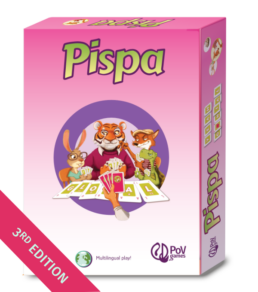
Each card is a letter in your hand that you can’t see. Instead, you see the cards of your opponents. Exchange hints and make words by ‘stealing’ other player’s letters.
Pispa (or Pluck! in English) promotes linguistic diversity and esteem for vocabulary, activates memory, increases visual-mental association, gives free rein to strategy, sustains collaboration. See more …
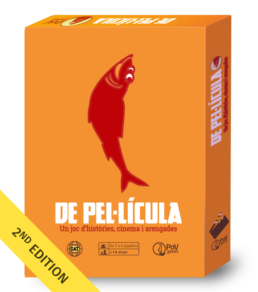
A frustrated collective of writers has been commissioned for a genuine genre film. As competition arises, you decide to have a pitching tournament to choose who will be the author of this film. Get the most votes and the maximum points to come out first! See more…
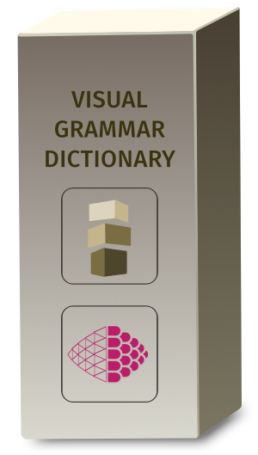
Each card plays with a visual concept like Composition, Fundamentals, Principles or even Attitudes and is complemented by an example card. The box contains two rule sets, but serves also as an aid in the design process, or as a conversation piece between designers and clients. Whichever use, it’s aim is to improve visual literacy.
(An English version might follow. For now only Catalans can save our planet)
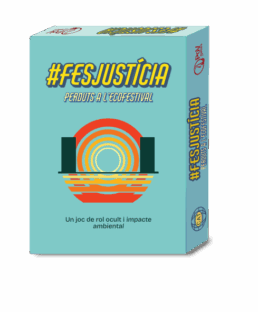
Som al 2054, a les portes del Tribunal Internacional de la Iaia, quan les situacions d’emergència climàtica han devastat mig planeta. Estem PERDUTS?

A visual challenge in the shape of a image matching game
One of the 21st century skills on literacy directs to the mediated surrounding. Practicing to understand how images are made, what they mean, or how they create emotions and generate impact is crucial. My Photography Game helps to unravel the visual elements in photographs, paintings and illustrations. See more…
and we help with Pedagogical advice
Knowledge transfer is at the basis of our practice; we revolve around visual literacy, creative processes, diversity and inclusion. We design learning tools and games, and advice organizations with their challenges on these topics.
Visual Literacy
We help you acquiring critical knowledge and counter-visuality tools to deconstruct the flow of constant mediated images and input.
Creative Processes
We guide and implement practice-based research into one’s own unique practice. Participants become conscious of all the different phases and creative obstacles that are present in their creative process.
Inclusive Pedagogies
We (help) develop learning tools focused on diversity and inclusion with the aim of countering assimilation and the influence of normativity.
Our Approach
In our professional lives we became more and more dedicated to developing and designing learning tools in which critical thinking is key. We care for different ways of learning-improving-growing in which teaching and learning is approached as a commutation of knowledge.
In all our games, projects and advices we blend pedagogy and game theory into a ludodidactic approach. After all: play is the best way to learn.

Rosa Pons
Rosa Pons-Cerdà is at the moment involved in a research on subliminal image-messages, and in exploring the qualities of blended learning for decolonizing courses. To give back what she has learned, she brings her experience into workshops and learning methods within the frame of intersectionality. Her work craves for communicating and educating to promote civic responsibility. Director of documentaries for social justice and archiving peoples memories (TV3, TVE2, Via Digital, Canal+, Radio Televisao Portuguesa); curator of DobleClick, a European Student’s Film Festival organized without hierarchies, where students were giving workshops about their practices and experimentation (2010-2015) ; lecturer at Universitat de Vic, Barcelona (2005-2016), researcher in academic innovation groups (CIFE-GI and AQUID, 2009-2013). Her studies cover a range of disciplines: graduate in Philology (UAB, 1994), in Media (EMAV, 1995), postgraduate in Actor’s Direction (URL, 2002), master in Writing for Cinema and Television (URL, 2008), all in Barcelona; and “updated” in Design and Development of Games for Learning (Edx, 2016).

Lenno Verhoog
In professional context Lenno Verhoog is a designer, educator and advisor. He now holds a position at the ministery of Justice as senior advisor on Knowledge and strategic matters. Previously working as a course leader at the Image & Media Technology department of University of the Arts, Utrecht, he actively contributed to the education of ‘reflective practitioners’ and of ‘designerly ways of thinking’ with a special focus on creative processes and visual literacy.
An applied arts studies (Ba); was at the base of his carreer as media designer at V2_lab, where he contributed to a wide range of projects on data visualisation; interactive installations; online applications; and the Dutch Electronic Art Festival (DEAF). In 2016 he successfully finished the master Education in Arts (MEd) with a practice-based research project on Playful Learning Experiences.